
Journal: PLOS Computational Biology, 15(9), e1007356
Author: Sanggeun Song1,2, Gil-Suk Yang1,2, Seong Jun Park1,2, Sungguan Hong2*, Ji-Hyun Kim1*, and
Jaeyoung Sung1,2*
1 Center for Chemical Dynamics in Living Cells, Chung-Ang University, Seoul 06974, Korea.
2 Department of Chemistry, Chung-Ang University, Seoul 06974, Korea.
DOI: https://doi.org/10.1371/journal.pcbi.1007356
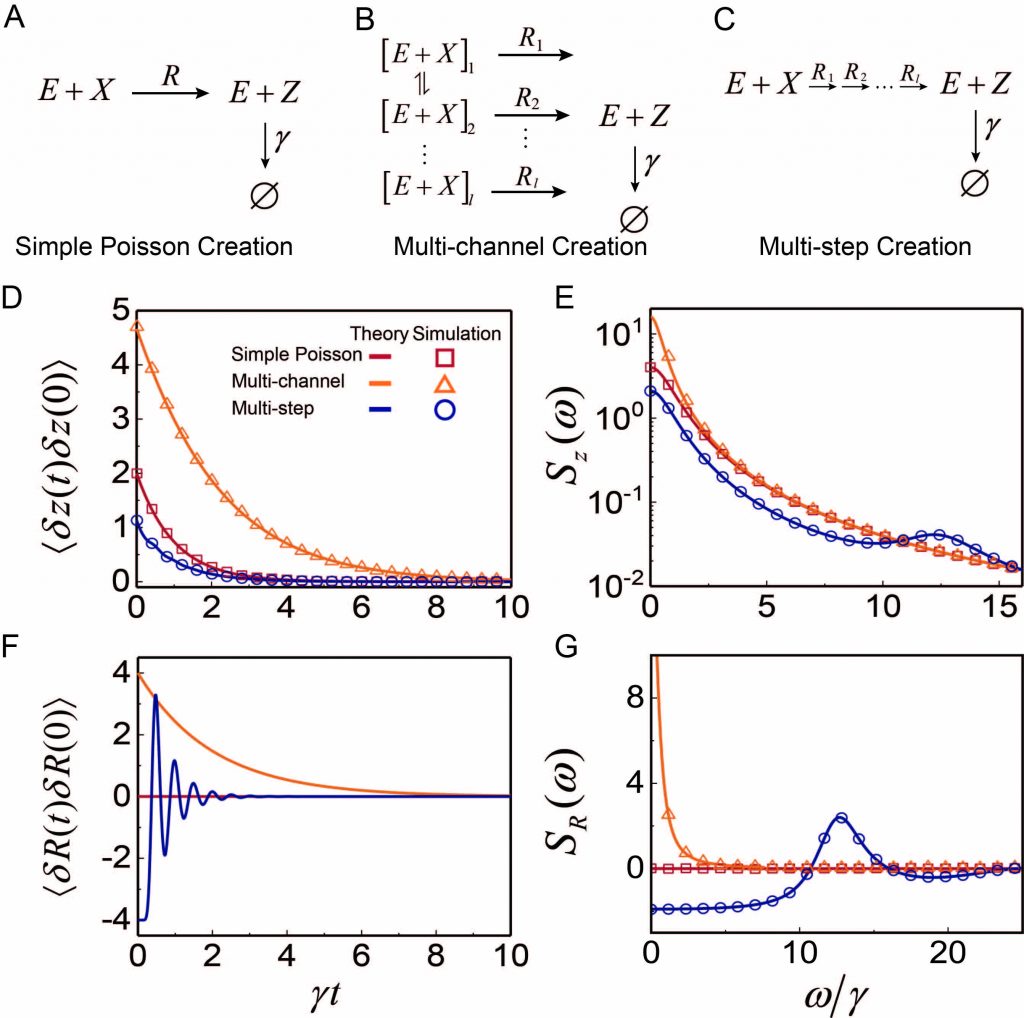
Even in the steady-state, the number of biomolecules in living cells fluctuates dynamically, and the frequency spectrum of this chemical fluctuation carries valuable information about the dynamics of the reactions creating these biomolecules. Recent advances in single-cell techniques enable direct monitoring of the time-traces of the protein number in each cell; however, it is not yet clear how the stochastic dynamics of these time-traces is related to the reaction mechanism and dynamics. Here, we derive a rigorous relation between the frequency-spectrum of the product number fluctuation and the reaction mechanism and dynamics, starting from a generalized master equation. This relation enables us to analyze the time-traces of the protein number and extract information about dynamics of mRNA number and transcriptional regulation, which cannot be directly observed by current experimental techniques. We demonstrate our frequency spectrum analysis of protein number fluctuation, using the gene network model of luciferaseexpression under the control of the Bmal 1a promoter in mouse fibroblast cells. We also discuss how the dynamic heterogeneity of transcription and translation rates affects the frequency-spectra of the mRNA and protein number.