
Journal: Proceedings of the National Academy of Sciences of the United States of America 116 (26), 12733-12742 (2019)
Author: Sanggeun Songa,b,c, Seong Jun Parka,b,c, Minjung Kimd, Jun Soo Kime, Bong June Sungf, Sangyoub Leed, Ji-Hyun Kima,1, and Jaeyoung Sunga,b,c,1
aCreative Research Initiative Center for Chemical Dynamics in Living Cells, Chung-Ang University, 06974 Seoul, Republic of Korea; bDepartment of Chemistry, Chung-Ang University, 06974 Seoul, Republic of Korea; cNational Institute of Innovative Functional Imaging, Chung-Ang University, 06974 Seoul, Republic of Korea; dDepartment of Chemistry, College of Natural Sciences, Seoul National University, 08826 Seoul, Republic of Korea; eDepartment of Chemistry and Nanoscience, Ewha Womans University, 03760 Seoul, Republic of Korea; and fDepartment of Chemistry, Sogang University, 04107 Seoul, Republic of Korea
DOI: https://doi.org/10.1073/pnas.1900239116
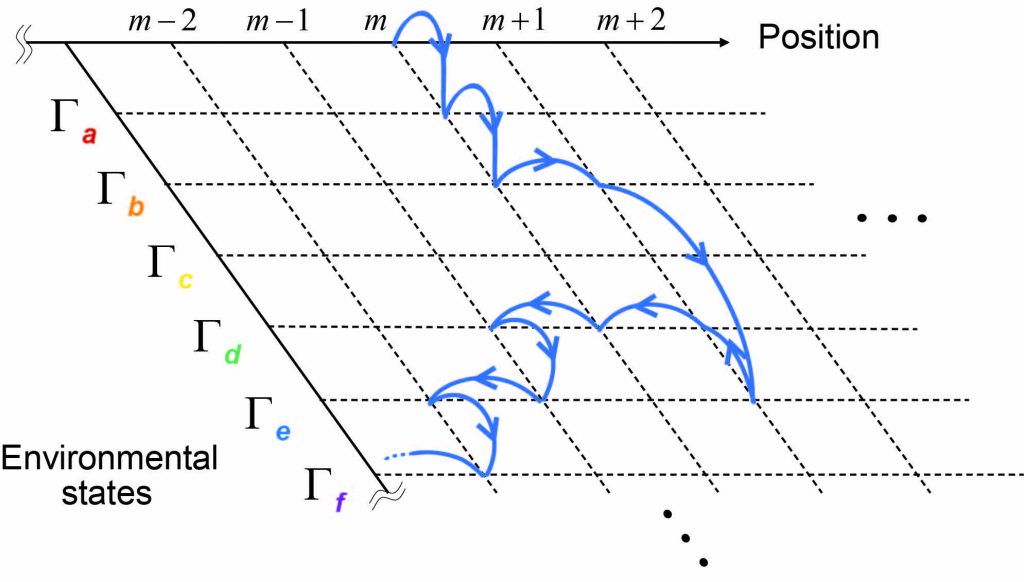
Thermal motion in complex fluids is a complicated stochastic process but ubiquitously exhibits initial ballistic, intermediate sub-diffusive, and long-time diffusive motion, unless interrupted. Despite its relevance to numerous dynamical processes of interest in modern science, a unified, quantitative understanding of thermal motion in complex fluids remains a challenging problem. Here, we present a new transport equation and its solutions, which yield a unified quantitative explanation of the mean square displacement (MSD), the non-Gaussian parameter (NGP), and the displacement distribution. In our approach, the environment-coupled transport kernel and its time correlation function are the essential quantities determining transport dynamics of complex fluids. We construct a general, explicit model of the transport kernel, which quantitatively explains transport dynamics of various complex fluidic systems such as supercooled water, colloidal particles diffusing on lipid tubes and dense hard disc. We introduce the concepts of intrinsic disorder and extrinsic disorder that have distinct effects on transport dynamics and different dependencies on temperature and density. This work presents a new direction in quantitative understanding of transport and transport-coupled processes in complex disordered media.