
Journal: Nature Communications 9, Article number: 297 (2018)
Author: Seong Jun Park1-3, Sanggeun Song1-3, Gil-Suk Yang1, Philip M. Kim4, Sangwoon Yoon2*, Ji-Hyun Kim1*, and Jaeyoung Sung1-3*
1 Creative Research Initiative Center for Chemical Dynamics in Living Cells, Chung-Ang University, Seoul 06974, Korea.
2 Department of Chemistry, Chung-Ang University, Seoul 06974, Korea.
3 National Institute of Innovative Functional Imaging, Chung-Ang University, Seoul 06974, Korea.
4 Terrence Donnelly Center for Cellular and Biomolecular Research, Department of Molecular Genetics and Department of Computer Science, University of Toronto, Toronto M5S 3E1, Canada.
DOI: https://doi.org/10.1038/s41467-017-02737-0
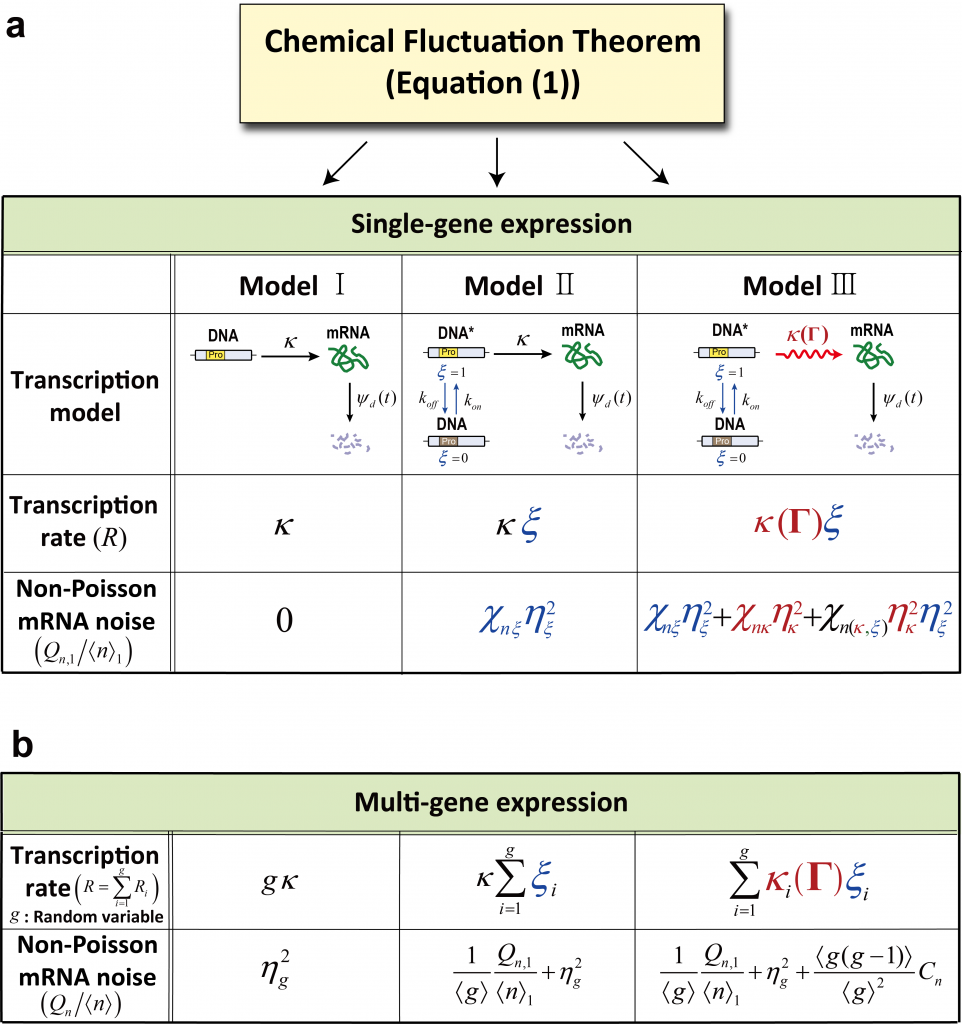
Gene expression is a complex stochastic process composed of numerous enzymatic reactions with rates coupled to hidden cell-state variables. Despite advances in single-cell technologies, the lack of a theory accurately describing the gene expression process has restricted a robust, quantitative understanding of gene expression variability among cells. Here we present the Chemical Fluctuation Theorem (CFT), providing an accurate relationship between the environment-coupled chemical dynamics of gene expression and gene expression variability. Combined with a general, accurate model of environment-coupled transcription processes, the CFT provides a unified explanation of mRNA variability for various experimental systems. From this analysis, we construct a quantitative model of transcription dynamics enabling analytic predictions for the dependence of mRNA noise on the mRNA lifetime distribution, confirmed against stochastic simulation. This work suggests promising new directions for quantitative investigation into cellular control over biological functions by making complex dynamics of intracellular reactions accessible to rigorous mathematical deductions.