
Journal: Science Advances Vol. 3, no. 9, e1700676 (2017)
Author: Sung Hyun Kim, TakKyoon Ahn, Tao Ju Cui, Sweeny Chauhan, Jaeyoung Sung, Chirlmin Joo, and Doseok Kim*
†Department of Physics and Interdisciplinary Program of Integrated Biotechnology, Sogang University, Seoul, Republic of Korea.
‡Department of Bionanoscience, Kavli Institute of NanoScience, Delft University of Technology, 2628 CJ Delft, Netherlands.
§Department of Chemistry, Chung-Ang University, Seoul, Republic of Korea.
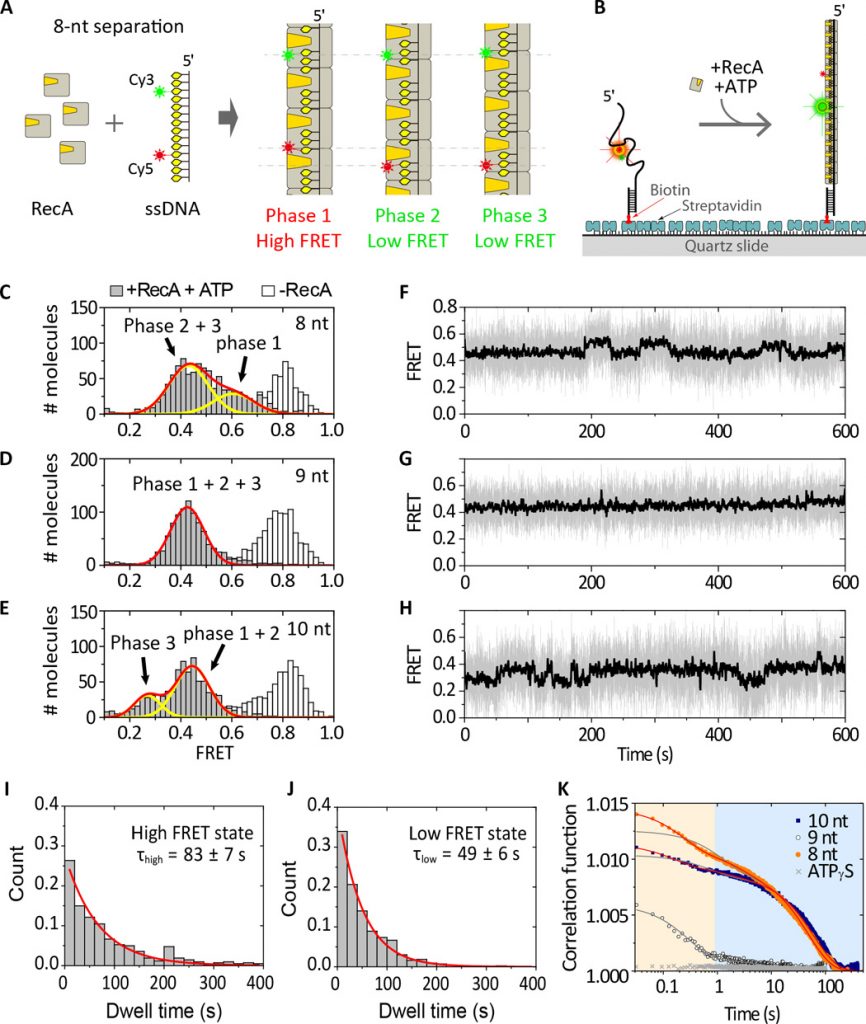
At the core of homologous DNA repair, RecA catalyzes the strand exchange reaction. This process is initiated by a RecA loading protein, which nucleates clusters of RecA proteins on single-stranded DNA. Each cluster grows to cover the single-stranded DNA but may leave 1- to 2-nucleotide (nt) gaps between the clusters due to three different structural phases of the nucleoprotein filaments. It remains to be revealed how RecA proteins eliminate the gaps to make a seamless kilobase-long filament. We develop a single-molecule fluorescence assay to observe the novel internal dynamics of the RecA filament. We directly observe the structural phases of individual RecA filaments and find that RecA proteins move their positions along the substrate DNA to change the phase of the filament. This reorganization process, which is a prerequisite step for interjoining of two adjacent clusters, requires adenosine triphosphate hydrolysis and is tightly regulated by the recombination hotspot, Chi. Furthermore, RecA proteins recognize and self-align to a 3-nt-period sequence pattern of TGG. This sequence-dependent phase bias may help the RecA filament to maintain structural integrity within the kilobase-long filament for accurate homology search and strand exchange reaction.