
Journal: Advanced Science
Author: Gyunam Park1,2,3†, Ji-Hyun Kim1,2†, Hunki Lee4, Chungwon Park5, Sidong Chen5, Luke Bates6, Jaeyoung Sung1,2,3* andHyokeun Park5,7,8*
1 Global Science Research Center for Systems Chemistry, Chung-Ang University, Seoul 06974, Korea.
2 Creative Research Initiative Center for Chemical Dynamics in Living Cells, Chung-Ang University, Seoul 06974, Korea
3 Department of Chemistry, Chung-Ang University, Seoul 06974, Korea.
4 Max-Planck Institute for Molecular Biomedicine, Röntgenstraße 20, 48149 Münster, Germany
5 Division of Life Science, The Hong Kong University of Science and Technology, Clear Water Bay, Kowloon, Hong Kong.
6 Department of Computer Science and Hessian Center for AI, Technical University of Darmstadt, Hochschulstraße 10, 64289 Darmstadt, Germany.
7 Department of Physics, The Hong Kong University of Science and Technology, Clear Water Bay, Kowloon, Hong Kong SAR, China
8 State Key Laboratory of Nervous System Disorders, The Hong Kong University of Science and Technology, Clear Water Bay, Kowloon, Hong Kong SAR, China.
9 School of Chemical and Biological Engineering, and Institute of Chemical Process Seoul National University; Seoul 08826, Korea.
10 Department of Materials Science and Engineering, Soongsil University; Seoul 06978, Korea.
11 Institute of Engineering Research, College of Engineering, Seoul National University; Seoul 08826, Korea.
12Advanced Institute of Convergence Technology, Seoul National University; Suwon, Gyeonggi 16229, Korea.
13 Department of Chemistry and Chemistry Institute for Functional Materials, Pusan National University, Busan 46241, Korea.
14 Department of Chemistry, Chungbuk National University, Chungbuk 28644, Korea.
15 Department of Nanoenergy Engineering, Pusan National University, Busan 46241, Korea
*To whom correspondences should be addressed.
† These authors equally contributed to this work.
DOI: https://doi.org/10.1002/advs.202513823
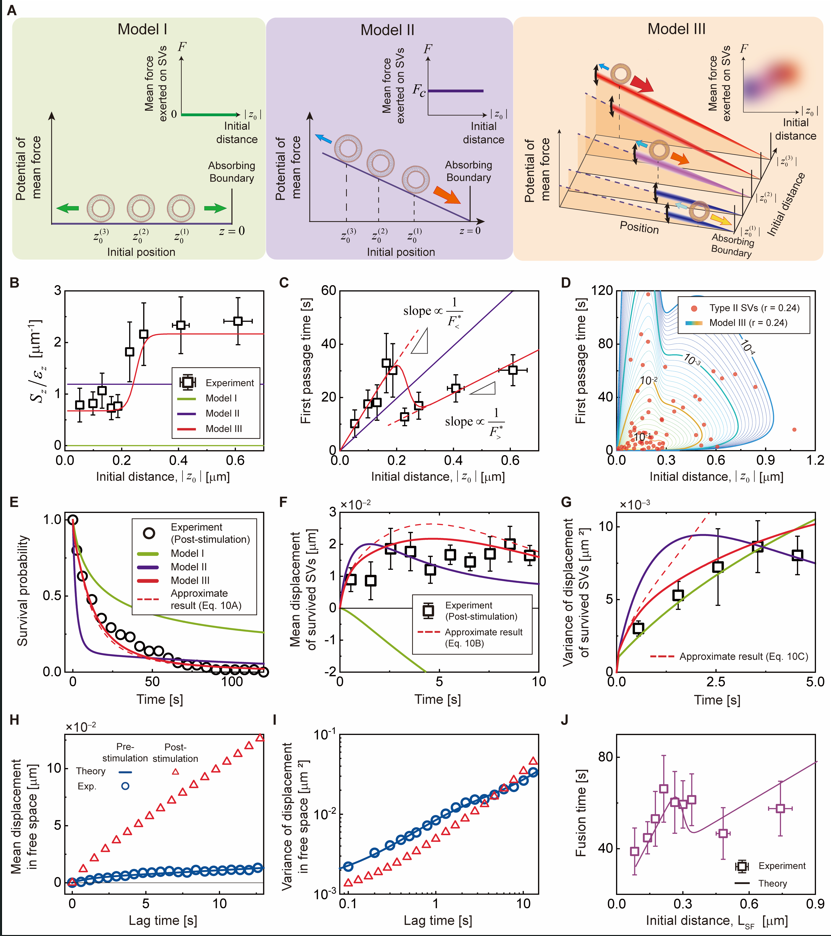
Neuronal communication occurs through transport and exocytosis of synaptic vesicles (SVs). However, their dynamics during neuronal stimulation remains poorly understood. Here, we quantitatively investigated real-time, three-dimensional motion of individual SVs undergoing exocytosis in presynaptic terminals. SVs are categorized into two types: Type I showing confined motion near fusion sites until exocytosis and Type II SVs exhibiting unconfined motion before tethering and exocytosis. Type II SVs have a broader fusion time distribution with a higher mean value than Type I SVs. Electrical stimulation increases the straightness of the Type II trajectories toward their fusion sites approximately tenfold. To quantify the straightness of the SV trajectories, we introduce a straightness parameter and establish its relationship to the mean force exerted on SVs. Interestingly, the straightness parameter, and hence mean velocity, increase in a sigmoidal manner with the initial distances of Type II SVs from their fusion sites upon stimulation, which results in a counterintuitive non-monotonic dependence of their fusion time on the initial distances. We present a quantitative model that simultaneously explains various experimental results regarding SV transport and fusion dynamics. This work offers new insights into mysterious SV motion at presynaptic terminals and its consequences on synaptic transmission of stimulated neurons.