
Journal: JACS
Author: Jingyu Kang1-3†, Donghee Kim1-3†, Sanggeun Song4,5†, Jonghwa Han1-3, Yongwon Jung1,6, Sangwoon Yoon3, Youngjae Ryu7, Sungjee Kim7, Byung Hyo Kim8-10, Jeong-Mo Choi1,13, Mino Yang14, Joonkyung Jang15, Taeghwan Hyeon8,9,11,
Jungwon Park8,9,11,12, Ji-Hyun Kim1-3, and Jaeyoung Sung1-3*
1 Global Science Research Center for Systems Chemistry, Chung-Ang University, Seoul 06974, Korea.
2 Creative Research Initiative Center for Chemical Dynamics in Living Cells, Chung-Ang University, Seoul 06974, Korea
3 Department of Chemistry, Chung-Ang University, Seoul 06974, Korea.
4 Department of Chemical and Biomolecular Engineering, University of California, Berkeley, Berkeley, California 94720, U.S.A.
5 Chemical Sciences Division, Lawrence Berkeley National Laboratory, Berkeley, California 94720, U.S.A.
6 Department of Chemistry, Korea Advanced Institute of Science and Technology, Daejeon 34141, Korea
7 Department of Chemistry, Pohang University of Science and Technology, Pohang 37673, Korea
8 Center for Nanoparticle Research, Institute for Basic Science (IBS); Seoul 08826, Korea.
9 School of Chemical and Biological Engineering, and Institute of Chemical Process Seoul National University; Seoul 08826, Korea.
10 Department of Materials Science and Engineering, Soongsil University; Seoul 06978, Korea.
11 Institute of Engineering Research, College of Engineering, Seoul National University; Seoul 08826, Korea.
12Advanced Institute of Convergence Technology, Seoul National University; Suwon, Gyeonggi 16229, Korea.
13 Department of Chemistry and Chemistry Institute for Functional Materials, Pusan National University, Busan 46241, Korea.
14 Department of Chemistry, Chungbuk National University, Chungbuk 28644, Korea.
15 Department of Nanoenergy Engineering, Pusan National University, Busan 46241, Korea
*To whom correspondences should be addressed.
Email: jaeyoung@cau.ac.kr; jihyunkim@cau.ac.kr; jungwonpark@snu.ac.kr
† These authors equally contributed to this work.
DOI: https://pubs.acs.org/doi/10.1021/jacs.5c10868
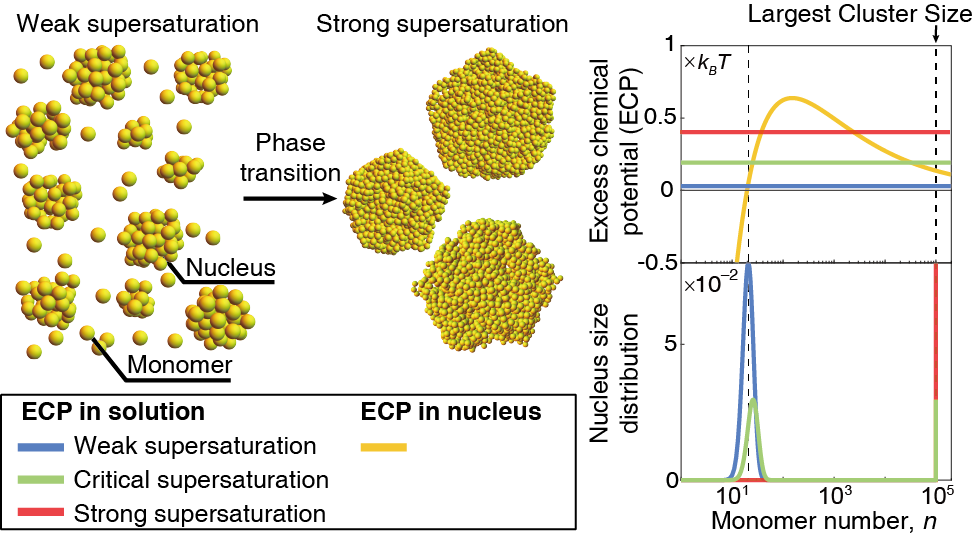
Supersaturation, nucleation, and phase separation are ubiquitous phenomena of great interest in both science and industry. However, a unified, quantitative understanding of these phenomena has yet to be achieved for mesoscopic systems. Here, we present a set of general equations that determine the monomer saturation degree, the size distribution and free energy of mesoscopic systems, as well as their phase transition conditions. These equations reveal that, under supersaturation, the largest cluster size (LCS) is an important state-variable; the supersaturation degree decreases with the LCS, approaching unity in the macroscopic limit. We identify the critical supersaturation, at which the nuclei undergo the phase transition to form large crystals. Below this critical supersaturation, the nucleus size distribution is either a unimodal function or a monotonically decreasing function of size, depending on system and temperature. We also predict the most probable nucleus size and the direction of spontaneous changes of the LCS. Our theory provides a unified, quantitative explanation of the nucleus-size-distribution across six different systems, including nanoparticles and biological condensates. This work serves as a general theoretical framework useful for understanding and designing nucleation and phase transitions of mesoscopic systems.