
Jounal: Angewandte Chemie International Edition 64.14 (2025): e202425407.
Author: Yeonsoo Lim 1,+, Gyunam Park 1,2,+, Hojin An 1,+, Jonghwa Han 1,2, Joonhyun Bae 3, Ji-HyunKim, 1,2 Yan Lee * 4, Kyungtae Kang *3, Jaeyoung Sung *1,2, and Sunbum Kwon *1
1 Department of Chemistry, Chung-Ang University, 84 Heukseok-ro, Dongjak-gu, Seoul 06974, Republicof Korea
2 Creative Research Initiative Center for Chemical Dynamics in Living Cells, Chung-Ang University, 84Heukseok-ro, Dongjak-gu, Seoul 06974, Republic of Korea
3 Department of Applied Chemistry, Kyung Hee University, 1732 Deogyeong-daero, Giheung-gu, Yongin,Republic of Korea
4 Department of Chemistry, Seoul National University, 1 Gwanak-ro, Gwanak-gu, Seoul 08826, Republicof Korea*
Correspondence to: gacn@snu.ac.kr, kkang@khu.ac.kr, jaeyoung@cau.ac.kr, skwon@cau.ac.kr
[+] These authors contributed equally to this work
https://onlinelibrary.wiley.com/doi/10.1002/anie.202425407
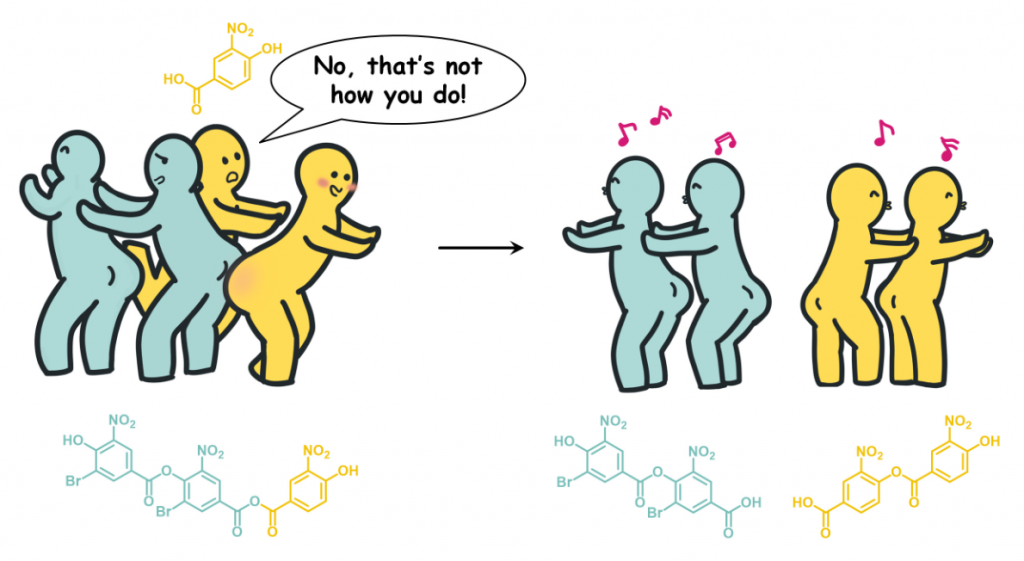
Metabolism is a complex network of chemical reactions in which transient biomolecules are continuously produced and degraded. Mimicking this dynamic process in synthetic systems poses a considerable challenge, as it requires designs that enable the exchange of energy and matter among transient molecules. In this study, we explored a chemically driven oligoesterification process operating within a highly intricate reaction network and constructed a dynamic library of transient oligoesters. Our kinetic analysis uncovered an intriguing phenomenon: oligoesters undergo parasitic exchanges, consuming one another to sustain the system’s dynamics before reaching thermodynamic equilibrium. This discovery opens new opportunities for designing synthetic systems that replicate the complexity and self-sustaining behavior of metabolic processes.