
Jounal: Chemical & Biomedical Imaging 2(5) (2024): 362-373
Author: Eunsang Lee1, Donghee Kim2,3,4, Yo Han Song1, Kyujin Shin5, Sanggeun Song2,3,4, Minho Lee2,3,4, Yeongchang Goh1, Mi Hee Lim6, Ji-Hyun Kim2,3, Jaeyoung Sung2,3,4,* and Kang Taek Lee1,*
1 Department of Chemistry, School of Physics and Chemistry, Gwangju Institute of Science and Technology (GIST), Gwangju 61005, Republic of Korea
2 Creative Research Initiative Center for Chemical Dynamics in Living Cells, Chung-Ang University, Seoul 06974, Republic of Korea
3 Department of Chemistry, Chung-Ang University, Seoul 06974, Republic of Korea
4 National Institute of Innovative Functional Imaging, Chung-Ang University, Seoul 06974, Republic of Korea
5 Materials Research & Engineering Center (MREC), R&D Division, Hyundai Motor Company, Uiwang 16082, Republic of Korea
6 Department of Chemistry, Korea Advanced Institute of Science and Technology (KAIST), Daejeon 34141, Republic of Korea
* Email: jaeyoung@cau.ac.kr and ktlee@gist.ac.kr
https://doi.org/10.1021/cbmi.4c00016
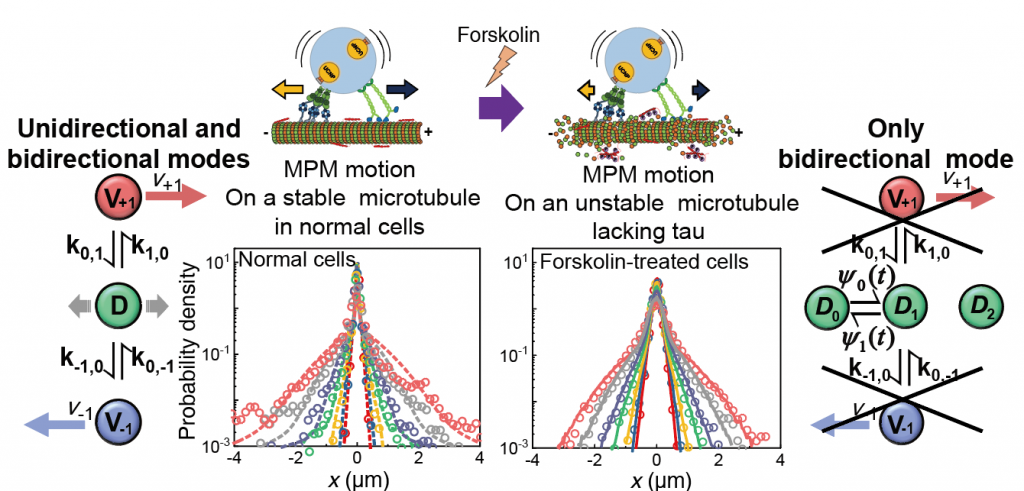
Synaptic vesicle transport by motor proteins along microtubules is a crucial active process underlying neuronal communication. It is known that microtubules are destabilized by tau-hyperphosphorylation, which causes tau proteins to detach from microtubules and form neurofibril tangles. However, how tau-phosphorylation affects transport dynamics of motor proteins on the microtubule remains unknown. Here, we discover that long-distance unidirectional motion of vesicle-motor protein multiplexes (VMPMs) in living cells is suppressed under tau-hyperphosphorylation, with the consequent loss of fast vesicle-transport along the microtubule. The VMPMs in hyperphosphorylated cells exhibit seemingly bidirectional random motion, with dynamic properties far different from VMPM motion in normal cells. We establish a parsimonious physicochemical model of VMPM’s active motion that provides a unified, quantitative explanation and predictions for our experimental results. Our analysis reveals that, under hyperphosphorylation conditions, motor-protein-multiplexes have both static and dynamic motility fluctuations. The loss of the fast vesicle-transport along the microtubule can be a mechanism of neurodegenerative disorders associated with tau-hyperphosphorylation.