
Journal: Science Advances 7, 49 (2021)
Author: Sungsu Kang1,2†, Ji-Hyun Kim3,4†, Minyoung Lee1, Ji Woong Yu1, Joodeok Kim1, Dohun Kang1, Hayeon Baek1, Yuna Bae1, Byung Hyo Kim5, Seulki Kang6, Sangdeok Shim7, So-Jung Park6, Won Bo Lee1, Taeghwan Hyeon1,2, Jaeyoung Sung3,4*, Jungwon Park1,2*
1 School of Chemical and Biological Engineering, and Institute of Chemical Process, Seoul National University, Seoul 08826, Republic of Korea
2 Center for Nanoparticle Research, Institute for Basic Science (IBS), Seoul 08826, Republic of Korea
3 Department of Chemistry, Chung-Ang University, Seoul 06974, Republic of Korea
4 Center for Chemical Dynamics in Living Cells, Chung-Ang University, Seoul 06974, Republic of Korea
5 Department of Organic Materials and Fiber Engineering, Soongsil University, Seoul 06978, Republic of Korea
6 Department of Chemistry and Nanoscience, Ewha Womans University, Seoul 03760, Republic of Korea
7 Department of Chemistry, Sunchon National University, Suncheon 57922, Republic of Korea
† These authors contributed equally to this work.
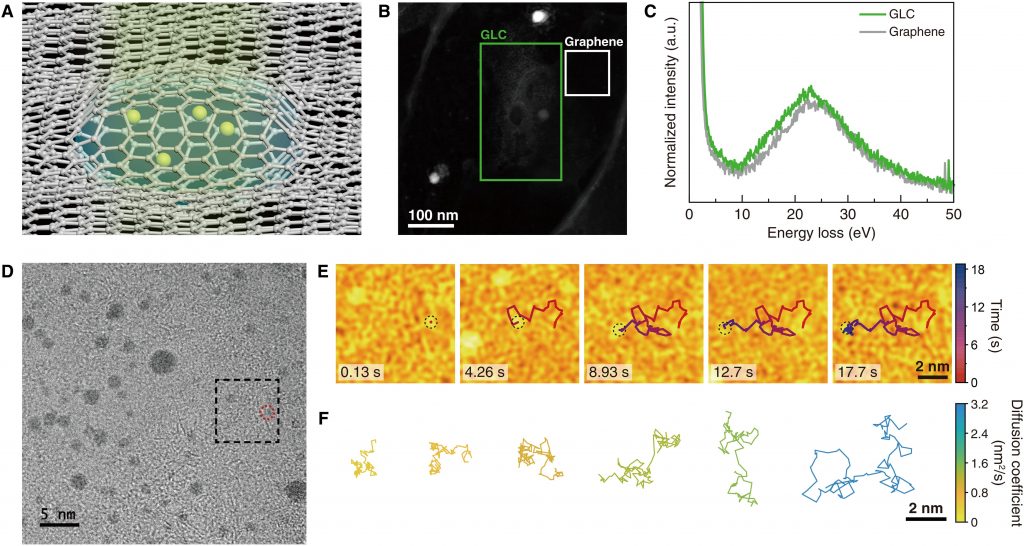
Thermal motion of colloidal nanoparticles and their cohesive interactions are of fundamental importance in nanoscience but are difficult to access quantitatively, primarily due to the lack of the appropriate analytical tools to investigate the dynamics of individual particles at nanoscales. Here, we directly monitor the stochastic thermal motion and coalescence dynamics of gold nanoparticles smaller than 5 nm, using graphene liquid cell (GLC) transmission electron microscopy (TEM). We also present a novel model of nanoparticle dynamics, providing a unified, quantitative explanation of our experimental observations. The nanoparticles in a GLC exhibit non-Gaussian, diffusive motion, signifying dynamic fluctuation of the diffusion coefficient due to the dynamically heterogeneous environment surrounding nanoparticles, including organic ligands on the nanoparticle surface. Our study clearly shows that the dynamics of nanoparticle coalescence is controlled by two elementary processes: diffusion-limited encounter-complex formation and the subsequent coalescence of the encounter complex through rotational motion, where surface-passivating ligands play a critical role.