
Journal: Nature Communications, 13 6506 (2022)
Author: Chae Won Kang1,a, Hyun Gyu Lim1,a, Jaehyuk Won2,3,a, Sanghak Cha1, Giyoung Shin4, Jae-Seong Yang5, Jaeyoung Sung2,3, Gyoo Yeol Jung1,4,*
1Department of Chemical Engineering, Pohang University of Science and Technology, 77 Cheongam-Ro, Nam-Gu, Pohang, Gyeongbuk 37673, Korea
2Creative Research Initiative Center for Chemical Dynamics in Living Cells, Chung-Ang University, 84 Heukseok-Ro, Dongjak-gu, Seoul, 06974, Republic of Korea
3Department of Chemistry, Chung-Ang University, 84 Heukseok-Ro, Dongjak-gu, Seoul, 06974, Republic of Korea
4School of Interdisciplinary Bioscience and Bioengineering, Pohang University of Science and Technology, 77 Cheongam-Ro, Nam-Gu, Pohang, Gyeongbuk 37673, Korea.
5Centre for Research in Agricultural Genomics (CRAG), CSIC-IRTA-UAB-UB, Campus UAB, Bellaterra, Barcelona, 08193, Spain
aThese authors contributed equally.
*Corresponding author:
DOI: https://doi.org/10.1038/s41467-022-34190-z
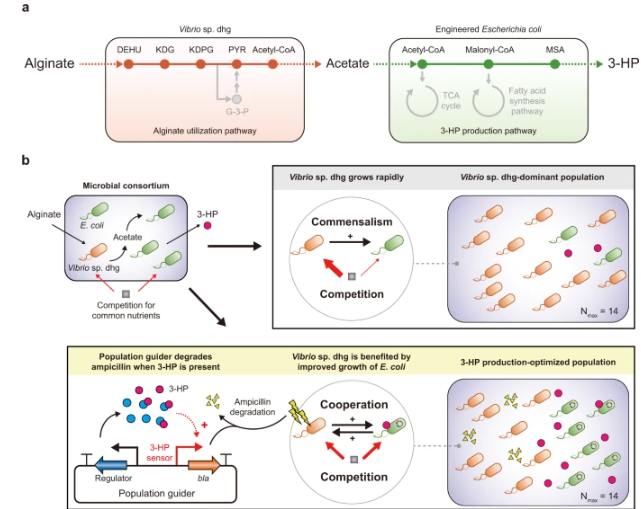
Microbial consortia have been considered potential platforms for bioprocessing applications. However, the complexity in process control owing to the use of multiple strains necessitates the use of an efficient population control strategy. Herein, we report circuit-guided synthetic acclimation as a strategy to improve biochemical production by a microbial consortium. We designed a consortium comprising alginate-utilizing Vibrio sp. dhg and 3-hydroxypropionic acid (3-HP)-producing Escherichia coli strains for the direct conversion of alginate to 3-HP. We introduced a genetic circuit, named “Population guider”, in the E. coli strain, which degrades ampicillin only when 3-HP is produced. In the presence of ampicillin as a selection pressure, the consortium was successfully acclimated for increased 3-HP production by 4.3-fold compared to that by a simple co-culturing consortium during a 48-h fermentation. We believe this concept is a useful strategy for the development of robust consortium-based bioprocesses.