
Journal: Physical Review E 102, 042612 (2020)
Author: Seungsoo Hahn 1,2 Sanggeun Song ,2,3,4 Gil-Suk Yang,2,4 Jingyu Kang,2,3,4 Kang Taek Lee,5,* and Jaeyoung Sung 2,3,4,†
1 Da Vinci College of General Education, Chung-Ang University, Seoul 06974, Korea
2 Creative Research Initiative Center for Chemical Dynamics in Living Cells, Chung-Ang University, Seoul 06974, Korea
3 Department of Chemistry, Chung-Ang University, Seoul 06974, Korea
4 National Institute of Innovative Functional Imaging, Chung-Ang University, Seoul 06974, Korea
5 Department of Chemistry, Gwangju Institute of Science and Technology, Gwangju 61005, Korea
DOI: doi.org/10.1103/PhysRevE.102.042612
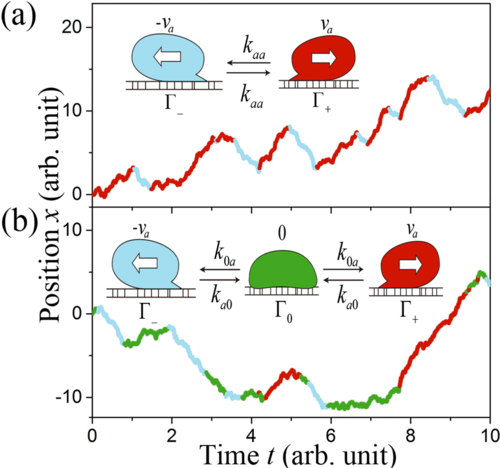
Living matter often exhibits multi-mode transport that switches between an active, selfpropelled motion and a seemingly passive, random motion. Here, we investigate an exactly solvable model of multi-mode active matter, such as living cells and motor proteins, which alternatingly undergoes active and passive motion. Our model study shows that the reversible transition between a passive mode and an active mode causes super-Gaussian transport dynamics, observed in various experiments. We find the non-Gaussian character of the matter’s displacement distribution is essentially determined by the population ratio between active and passive motion. Interestingly, under a certain population ratio of the active and passive modes, the displacement distribution changes from sub-Gaussian to super-Gaussian as time increases. The mean square displacement of our model exhibits transient superdiffusive dynamics, yet recovers diffusive behavior at both the short- and long-time limits. We finally generalize our model to encompass complex, multi-mode active matter in an arbitrary spatial dimension.