
Journal: Physical Chemistry Chemical Physics, 2020, 22, 21664-21671
Author: Kang-Kyun Wang,†a Sanggeun Song,‡bc Seung-Jin Jung,‡a Jung-Wook Hwang,a Min-Goo Kim,d Ji-Hyun Kim,c Jaeyoung Sung, *bc Jin-Kyu Lee*d and Yong-Rok Kim*a
a Department of Chemistry, Yonsei University, 50 Yonsei-ro, Seodaemun-gu, Seoul 03722, Republic of Korea
b Department of Chemistry, Chung-Ang University, Seoul 06974, Korea
c Creative Research Initiative Center for Chemical Dynamics in Living Cells, Chung-Ang University, Seoul 06974, Korea
d Corporate R&D, LG Chemical Ltd., LG Science Park, Seoul 07796, Korea
DOI: 10.1039/d0cp00739k
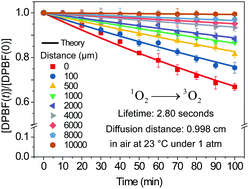
Singlet oxygen is a toxic chemical but powerful oxidant, exploited in many chemical and biological applications. However, the lifetime of singlet oxygen in air under atmospheric conditions is yet to be known. This has limited safe usage of singlet oxygen in air, despite being a strong antimicrobial agent with the unique property of relaxing to breathable oxygen after serving its purpose. Here, we solve this long-standing problem by combining experimental and theoretical research efforts; we generate singlet oxygen using a photosensitizer at a local source and monitor the time-dependent extent of singlet oxygen reaction with probe molecules at a detector, precisely controlling the detector distance from the source. To explain our experimental results, we employ a theoretical model that fully accounts for singlet oxygen diffusion, radiative and nonradiative relaxations, and the bimolecular reaction with probe molecules at the detector. For all cases investigated, our model, with only two adjustable parameters, provides an excellent quantitative explanation of the experiment. From this analysis, we extract the lifetime of singlet oxygen in the air to be 2.80 s at 23 °C under 1 atm, during which time singlet oxygen diffuses about 0.992 cm. The correctness of this estimation is confirmed by a simple mean-first-passage time analysis of the maximum distance singlet oxygen can reach from the source. We also confirm the sterilization effects of singlet oxygen for distances up to 0.6–0.8 cm, depending on the bacteria strain in question, between the bacteria and the singlet oxygen source.