
Journal: Journal of Physical Chemistry Letters 10, 3071-3079 (2019)
Author: Kyujin Shin†1, Sanggeun Song†2,3,4, Yo Han Song†1, Youngeun Han1, Seungsoo Hahn2,5, Ji-Hyun Kim2, Gibok Lee1, In-Chun Jeong2,3,4, Jaeyoung Sung*2,3,4, and Kang Taek Lee*1
1 Department of Chemistry, School of Physics and Chemistry, Gwangju Institute of Science and Technology (GIST), Gwangju, 61005, Korea.
2 Creative Research Initiative Center for Chemical Dynamics in Living Cells, Chung-Ang University, Seoul, 06974, Korea.
3 Department of Chemistry, Chung-Ang University, Seoul, 06974, Korea.
4 National Institute of Innovative Functional Imaging, Chung-Ang University, Seoul, 06974, Korea.
5 Da Vinci College of General Education, Chung-Ang University, Seoul, 06974, Korea.
DOI: https://doi.org/10.1021/acs.jpclett.9b01106
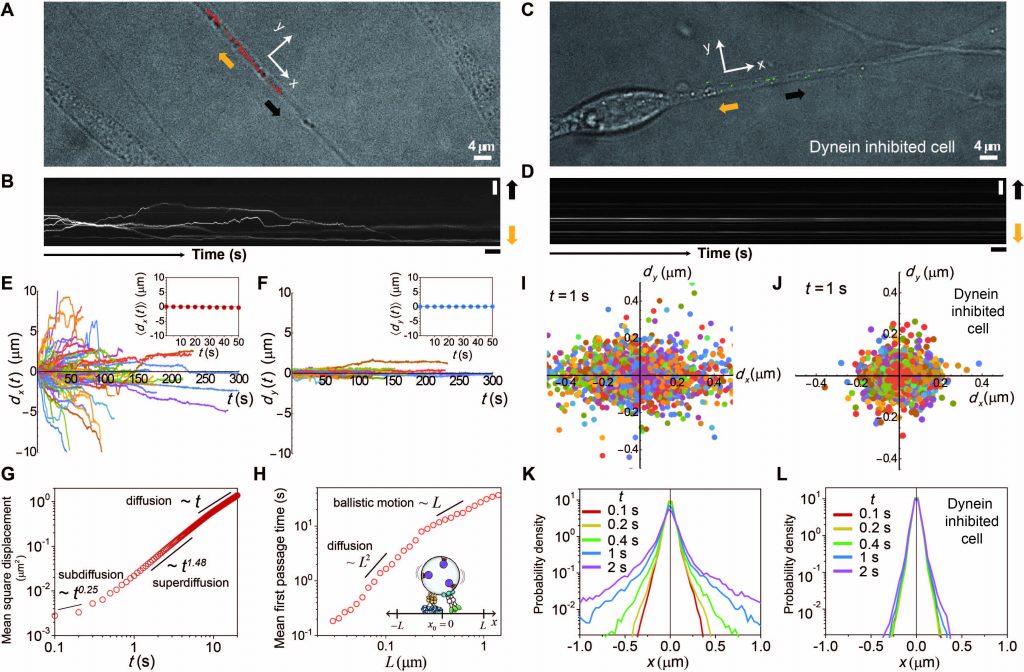
Vesicle-transport conducted by motor-protein-multiplexes, ubiquitous among eukaryotes, shows mysterious stochastic dynamics, qualitatively different from dynamics of thermal motion and artificial active matter; the relationship between in vivovesicle-delivery dynamics and dynamics of the underlying physicochemical processes is not yet quantitatively understood. Addressing this issue, we perform accurate label-free tracking of individual vesicles, containing upconversion nanoparticles free of photobleaching or photoblinking, transported by kinesin-dynein-multiplexes along axonal microtubules in human neuroblastoma cells. The mean-square-displacement (MSD) of vesicles along the microtubule exhibits unusual dynamic phase transitions, seemingly inconsistent with the scaling behavior of the mean-first-passage time (MFPT) over the travel length. These paradoxical results and the vesicle displacement distribution at all times are quantitatively explained and predicted by a multi-mode motor multiplex model, developed in the current work, where ATP-hydrolysis-coupled motion of kinesin-dynein-multiplexes has both unidirectional and bidirectional modes. From this analysis, we find the bidirectional mode is far more probable than the unidirectional mode, but the presence of the latter is essential for the dynamic phase transitions in the MSD and MFPT, general features of in vivovesicle motion. The experimental methods and theoretical models developed in the current work provide useful tools for quantitative investigation into complex transport dynamics of biological systems.