
Journal: The Journal of Chemical Physics
Author: Minho Lee1,2, Jinwon Park1,2, Ji-Hyun Kim1,2, Minhaeng Cho3,4* and Jaeyoung Sung1,2*
1 Global Science Research Center for Systems Chemistry, Chung-Ang University, Seoul 06974, Korea.
2 Creative Research Initiative Center for Chemical Dynamics in Living Cells, Chung-Ang University, Seoul 06974, Korea
3 Center for Molecular Spectroscopy and Dynamics, Institute for Basic Science (IBS), Seoul 02841, Republic of Korea
4 Department of Chemistry, Korea University, Seoul 02841, Republic of Korea
a)Authors to whom correspondence should be addressed:
mcho@korea.ac.kr and jaeyoung@cau.ac.kr
DOI: https://doi.org/10.1063/5.0334867
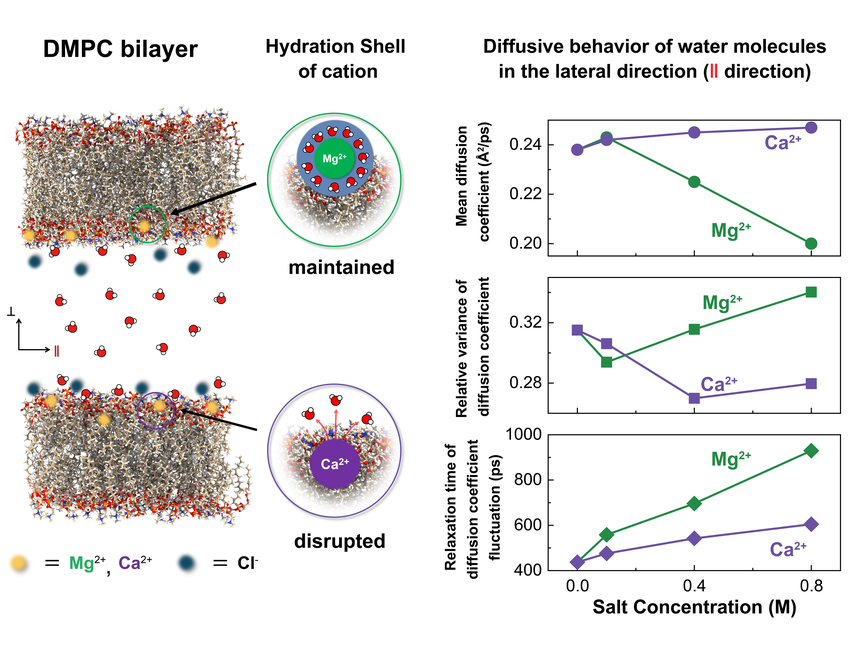
Biological water is an ionic solution containing both monovalent and divalent ions. However, the effects of divalent ions on the dynamics of biological water remain largely unknown. Here, we investigate how the transport dynamics of water molecules nanoconfined between lipid membranes depends on the concentration of calcium (Ca2+) and magnesium (Mg2+) ions by using molecular dynamics simulations and the generalized transport equation for biological water. We find that the diffusion coefficient of biological water monotonically increases with Ca2+ ion concentration but exhibits a largely opposite, non-monotonic dependence on Mg2+ concentration. The deviation of the water molecules’ displacement distribution from the Gaussian also shows a distinct dependence on the concentrations of Mg2+ and Ca2+. These contrasting behaviors originate from the different hydration radii of these divalent ions and their distinct effects on the interfacial structure and dynamics of biological water. The relaxation of the lateral displacement distribution of water molecules toward a Gaussian is determined by the time-correlation function of diffusion coefficient fluctuations, whose relaxation time increases with salt concentrations. The primary source of the lateral diffusion coefficient fluctuation is thermal motion of water molecules in the longitudinal direction, along which microscopic environments surrounding a water molecule, including the functional groups of lipid membrane and ion concentrations, drastically change.